Brighter / vertical comparison
Both clips share one timeline. The 14.375-second rough holds its last frame until the fifteen-second result ends.

Six input strategies. One locked sequence. A study of what motion preserves, reinterprets, and loses.
We used one fifteen-second scene to test a practical directing problem: what should come from the rough storyboard, and what should come from the finished character designs?
The scene follows a woman onto an empty white runway. Three seated doubles disappear as she dances, and their clothes transfer to her through a series of transformations. The rough already fixed the shots and blocking. Separate character sheets fixed her face, proportions, and wardrobe.
We first documented Brighter as an animation project in 2018. This test returns to one scene from that work with a narrower goal: compare six ways of directing Seedance 2.0 from the same material. Every result is fifteen seconds long and has no generated audio.
01 / Source material
Both clips share one timeline. The 14.375-second rough holds its last frame until the fifteen-second result ends.
The rough and approved final share one timeline. The rough holds its last frame for the final 2.533 seconds while the subtitled cut completes its full 17.533-second delivery.


For E and F, we split the original sheets into one face reference and one full figure for each costume. This removed extra views that could be mistaken for separate people.


02 / First pass
Full rough video
One synchronized player. The rough holds its final frame for the last 0.625 seconds.
The generated clip follows the storyboard coverage closely. It also copies the long holds and sudden pose changes, which makes the animation feel choppy.
Text and character art
The left panel changes at each timed prompt window so the active direction stays synchronized with the output.
The motion is less tied to the rough, but the camera positions, placement of the doubles, and order of events no longer match the planned scene.
Dense shot script
The left panel follows the seven timed windows in the generation prompt.
Detailed camera, blocking, and transformation directions recovered most of the scene without importing the storyboard pose timing. Some compositions still differ from the boards.
Paired storyboard frames
The complete storyboard frame grid remains visible while the result plays.
Start and end frames clarify the intended framing. The generated action tends to pause on those images instead of moving through them naturally.
03 / Refinement
Camera-only video role
The camera reference holds its final frame until the fifteen-second output ends.
The video supplies shot order, framing, screen direction, and blocking. The prompt rejects its anatomy, clothing, drawing style, pose timing, and cut lengths. The action is grouped into six longer phrases.
Sparse held-keyframe animatic
The sparse animatic and generated result share one fifteen-second timeline.
The input holds the beginning and end of each shot, with extra drawings around the cape transition. It leaves more room for continuous movement, although the final costume still drifts away from Look 4.
04 / Direction notes
A copied the storyboard holds and abrupt pose changes. Calling it a camera reference did not remove that signal completely.
Character images controlled face, body, costumes, linework, and color. Video and storyboard references handled framing, blocking, and screen direction.
Longer sections gave the motion more time for anticipation, weight shifts, overlap, and follow-through.
F retained the cuts and screen direction while giving the model fewer rough in-betweens to copy.
05 / Production transfer
The office shot is an unreleased clip from Remote Startup Senpai. Meiko remains offscreen while Hiro moves from a slumped response to a sudden stand, then walks out of frame. The rough carried the top-down camera, room layout, blocking, dialogue timing, and performance. A character sheet and seven rendered keyframes carried Hiro’s finished identity and drawing.
The authored action ends at 14.5 seconds, leaving the last half-second clear for the final delivery. After the silent render, the picture was conformed to exactly fifteen seconds and the original audio was restored.
Hiro is the only visible character. His sheet fixes the face, tired eyes, loose hair, camel jacket, black shirt, charcoal trousers, and brown shoes. Meiko’s sheet fixes the identity of the offscreen speaker, but she never enters the frame.


The tests separated motion, timing, composition, and finished drawing instead of asking one reference to do everything. A prepared seven-keyframe configuration had no completed output in the research folder, so it is not presented as a result below.
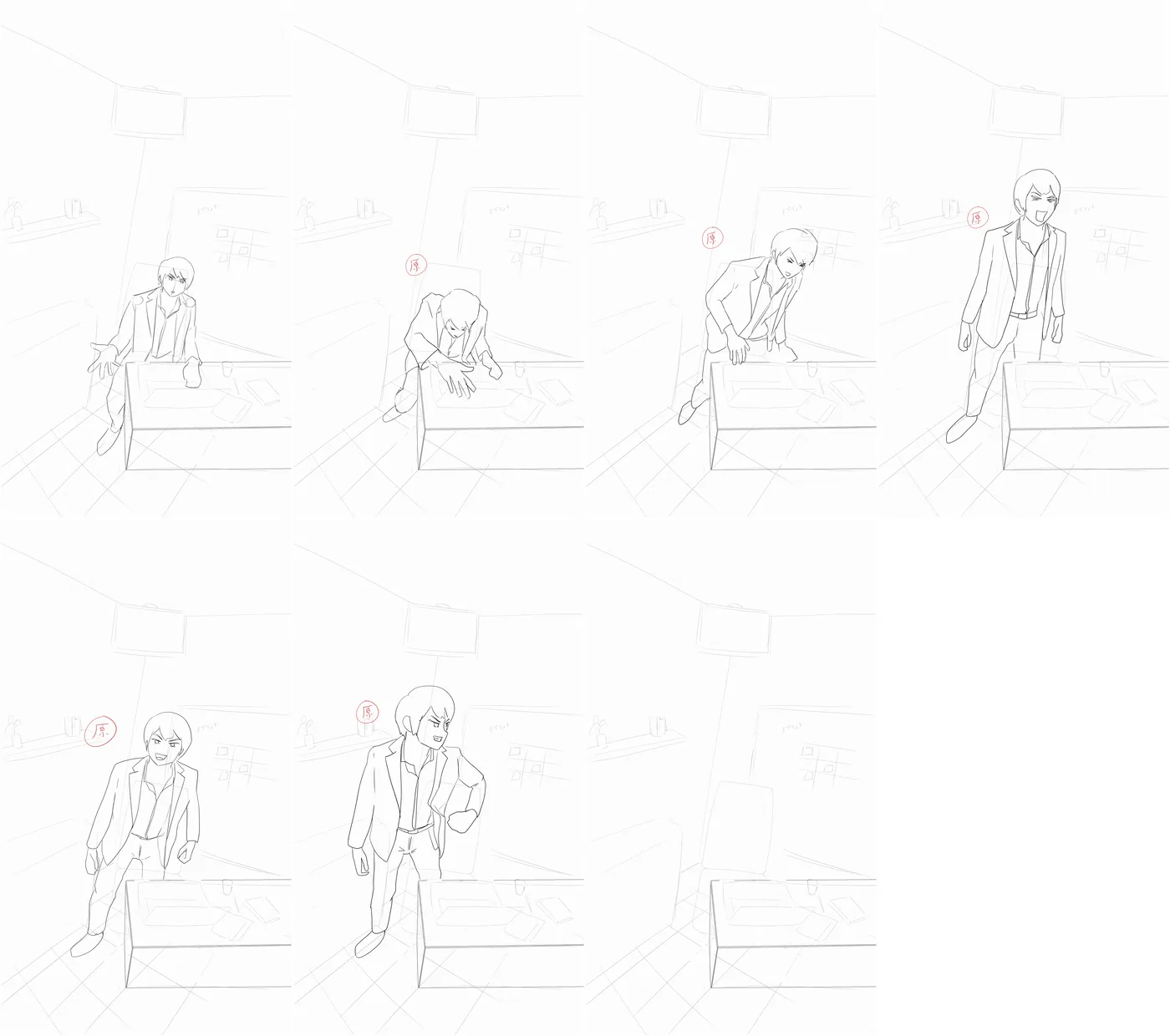

The moving rough supplied the locked camera, action order, dialogue timing, stand, exit path, and empty-office hold. The design sheets supplied the finished identity.
The complete input and output play on one fifteen-second timeline. Audio comes from this test output.


Without a motion video, seven broad poses carried composition and progression while the production audio supplied dialogue and lip-sync timing.

Keeping the motion brief and character authority comparable exposed changes in room design, drawing stability, and the strength of Hiro’s reaction.
The same motion-reference video is repeated here so the later output can be judged against its actual input rather than against the earlier output alone.
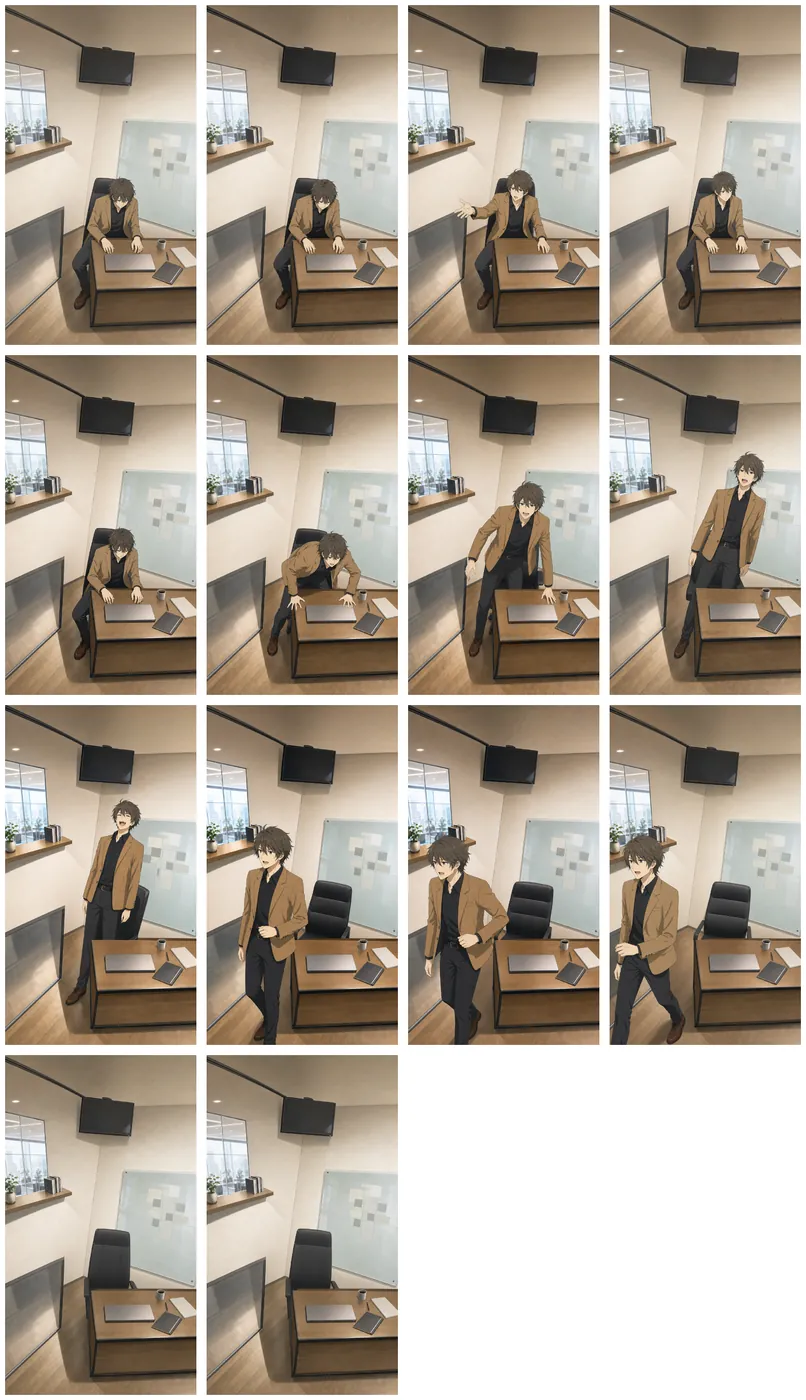
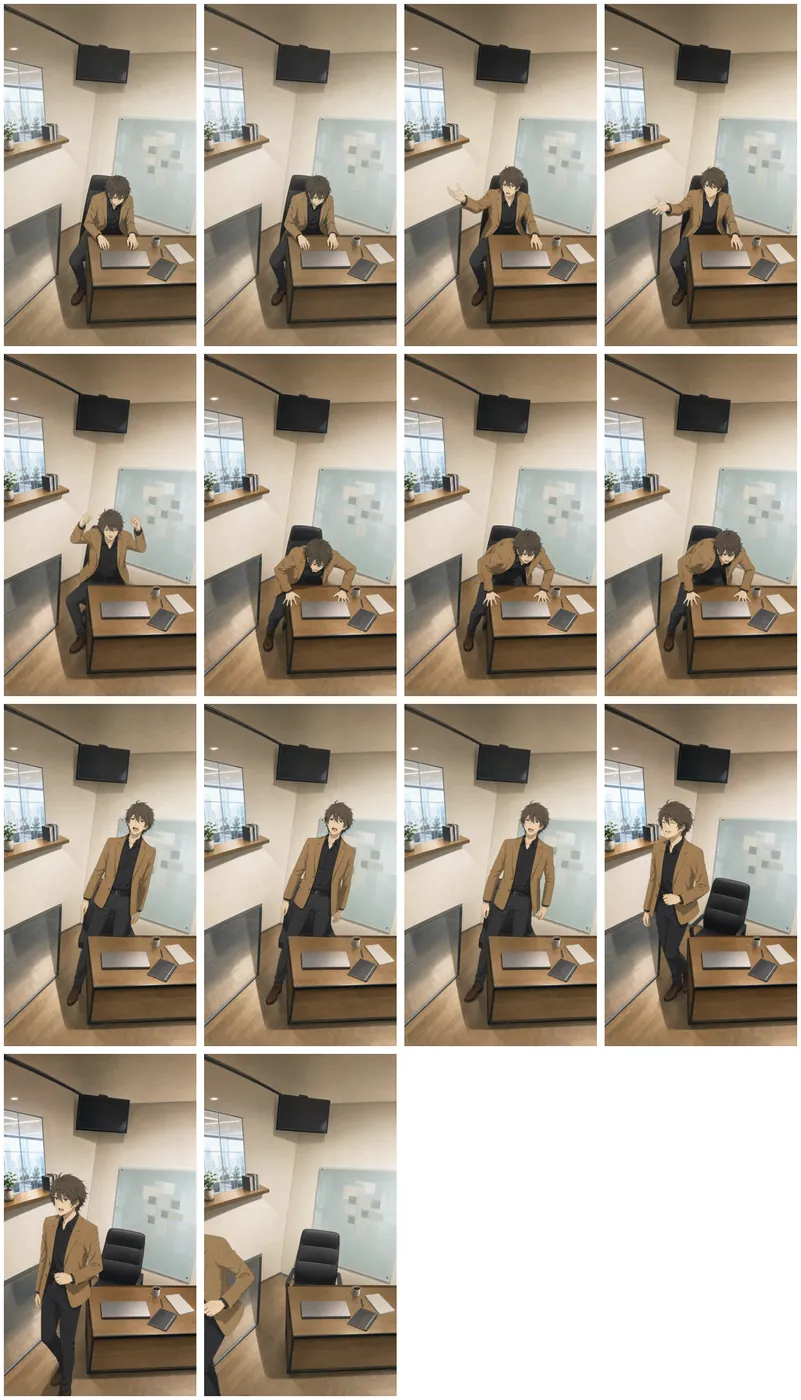
Fifteen polished keyframes fixed the important performance states while the rough remained responsible for continuous motion, timing, camera, and path.
This pass uses the same moving rough together with the chronological finished keyframes. Both sides remain synchronized for the full fifteen seconds.
The result preserves the 8.52-second reaction, exit by 12.96, and the final empty-office hold. The most important poses are fixed at authored instants rather than treated as separate shots.
Both sides use the same subtitles and production audio. The right side is the attempted restoration result.
The restoration clarified edges and facial detail, but it did not behave like a neutral upscale. The service returned 720 × 1280 at 24 fps and 17.375 seconds from a 1080 × 1920, 30 fps, 17.533-second source. Around Hiro’s comic emotional snap, the mouth shape and intensity shifted away from the approved performance.
Restoring the original audio, conforming the frame rate, and holding the final frame repaired the delivery length. Those steps could not restore the altered acting. The upscaled pass was rejected, and the approved source remains the production master.