Attempt 2
Nine still referencesThe early video retained an extra clone and a late cut.

Seven passes on one hand-directed shot. The strongest result came from fewer visual anchors and more precise direction.
We did not begin this five-second shot by asking a model to find the scene. We drew the performance, chose the important frames ourselves, and wrote the direction against seconds and milliseconds before generating anything.
The shot moves through three angles. Band equipment and two doubles dissolve into green and brown leaves and pale sakura. The material gathers into a gray notebook above the woman’s hand. A hard cut then reveals a man behind cracked glass as the camera moves toward him. The work recorded here is about making that staging readable while preserving continuous animation.
The hand-drawn rough above controls timing, camera, and acting. Attempt 7 below supplies the finished character, effects, and rendering.
01 / Manual direction
On paper, we marked the frames that had to survive the translation from rough motion to finished drawing. The list became 01a through 03c. The timing document then fixed them at 00:00.000, 00:01.014, 00:01.015, 00:02.002, 00:03.003, 00:03.004, 00:03.028, and 00:04.023.
The notes described what happened between those instants: camera movement, walking direction, which clone dissolved first, how far the notebook had formed, where the glass ended on the floor, and how the foreground tables changed scale during the push-in. The rough supplied pose and blocking. The production pass supplied design, anatomy, materials, light, and finish.

All eight candidates were finished so that camera, staging, and continuity could be reviewed before deciding which images to upload.
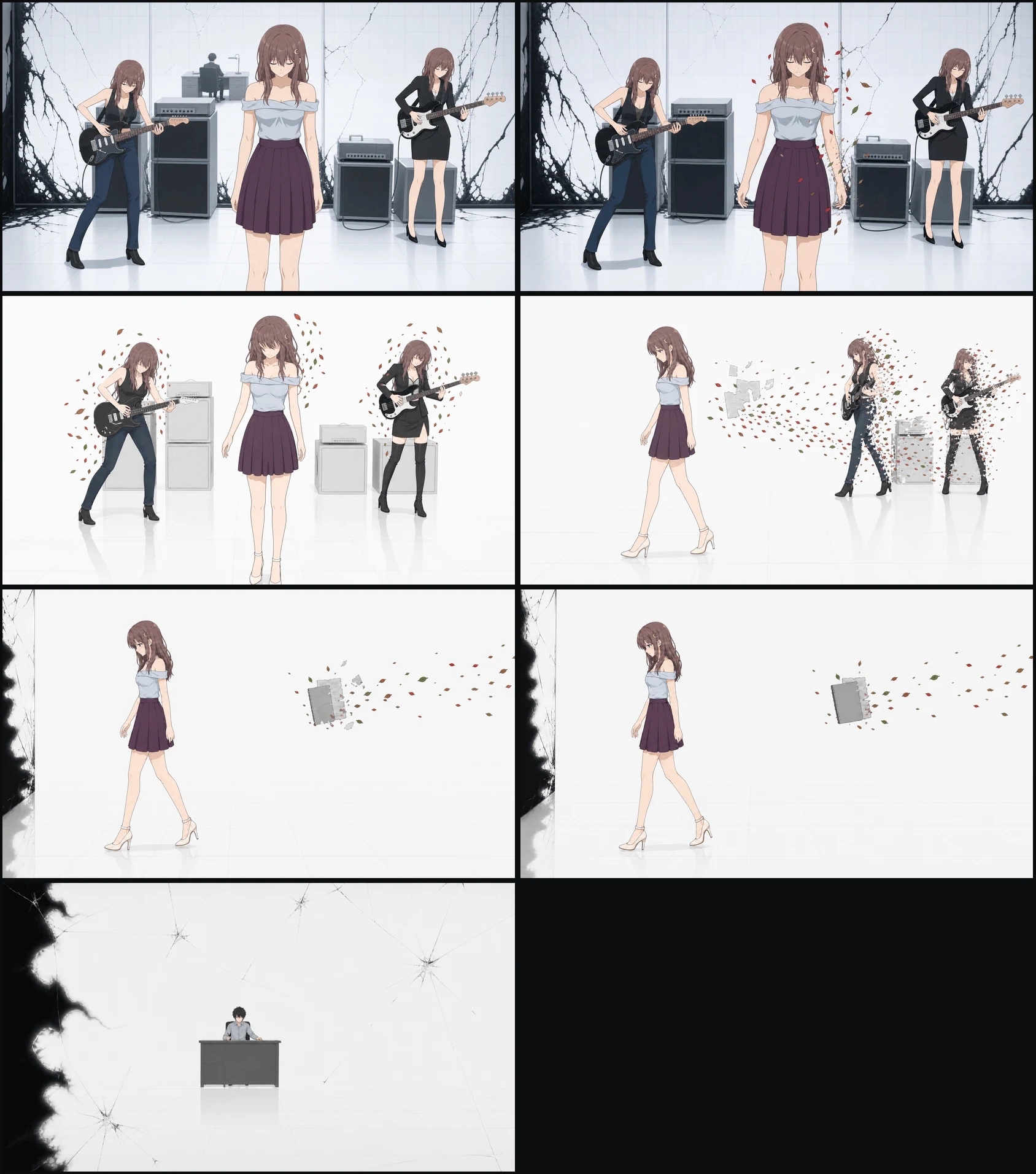
Attempt 1 remains useful as an input record. It exposed wrong dissolution targets, an unwanted wall position, and a weak final pose before the video workflow was locked.
02 / Reference authority
Attempt 4 uploaded all eight productionized frames. The room and compositions became clear, but the video began to move from still to still. Hair held its shape. Dissolution read as a set of percentages. The finished keyframes were useful for direction and review, yet too many of them became timing constraints.
Attempt 5 kept the same detailed direction and canonical character designs, then reduced the visual anchors to 01a, 02a, and 03a. These were the first frames after each cut. The rough video became the sole authority for timing, camera, paths, weight transfer, and continuous acting. The three images fixed only how each shot looked when it began.
Attempts 6 and 7 added one effects-only plate. It controlled the color and material language of the dissolution without supplying another character pose. The final package was a motion rough, one cast board, three shot-opening frames, and one FX plate.
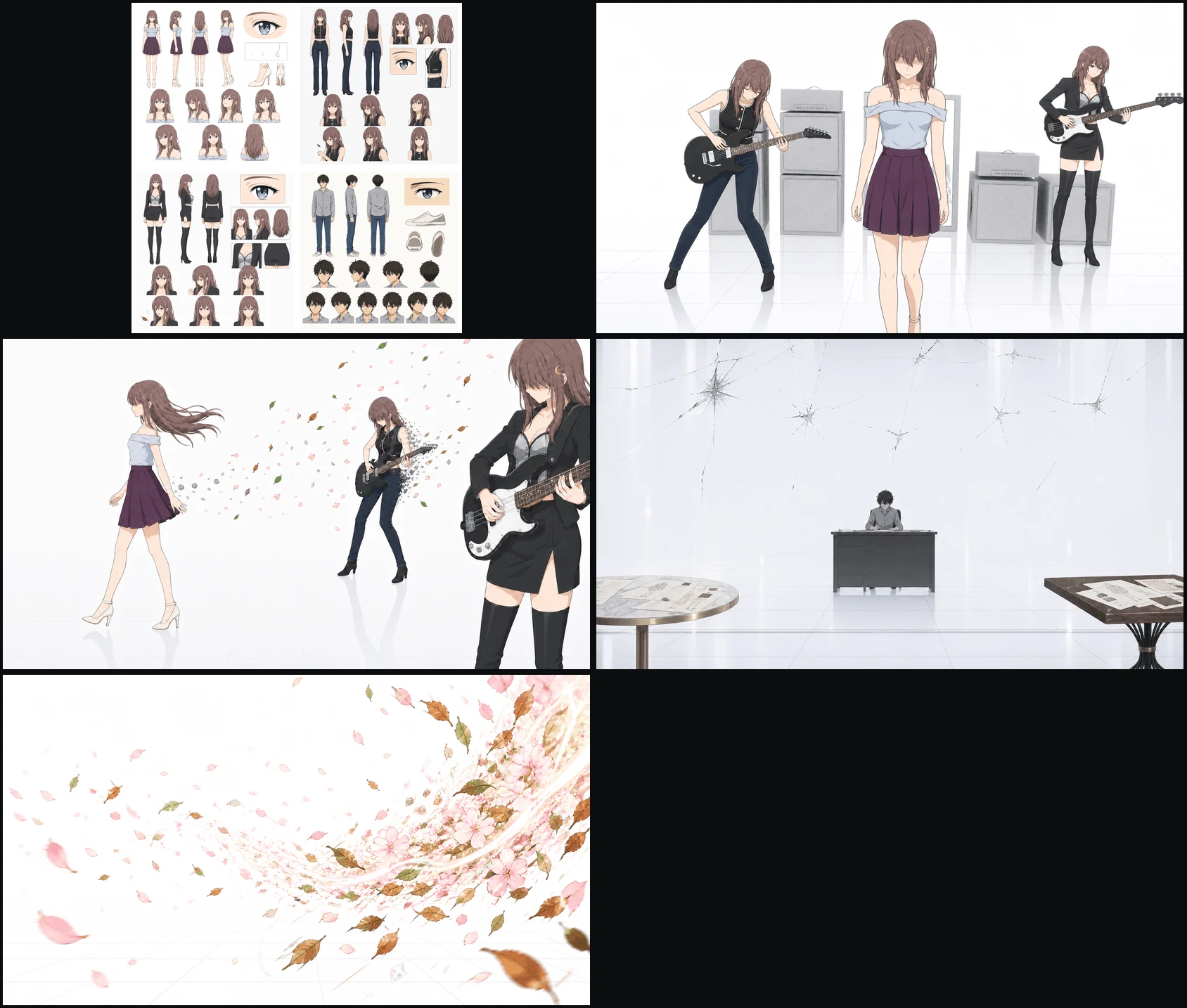
Character designs fixed identity and wardrobe. The three first frames fixed production appearance. The FX plate fixed colored foliage and magical layering. None of the stills controlled the in-between motion.
03 / Every retained output
Attempt 2 retained nine still references. Attempt 4 used eight productionized semantic keys. Attempt 5 reduced them to three shot openings. Attempt 6 added an effects plate. Attempt 7 added explicit animation mechanics to the timed direction.
The early video retained an extra clone and a late cut.
Composition held, while motion stalled between anchors.
Walking, hair, cloth, and particle paths became smoother.
Foliage color, magical layering, and glass continuity improved.
The final pass timed anticipation, release, overshoot, and follow-through.
| Pass | Inputs | Prompt | Observed result |
|---|---|---|---|
| 1 | Seven early keys | No video | The first visual pass retained incorrect dissolution and staging. |
| 2 | Rough + nine stills | 5,483 chars | The lead remained intact, but an extra clone and late cut remained. |
| 4 | Rough + eight finished keys | 3,418 chars | Composition held while motion stalled between anchors. |
| 5 | Rough + three shot openings | 3,285 chars | Walking, hair, cloth, and particle paths became smoother. |
| 6 | Pass 5 + FX plate | 3,431 chars | Foliage color, magic, glass, and table continuity improved. |
| 7 | Pass 6 + animation principles | 3,300 chars | The prompt specified anticipation, overshoot, falling petals, and notebook assembly over the palm. |
The full prompt files remain in the private production archive. The table records their exact retained lengths, reference packages, correction goals, and observed outputs. From Attempt 4 onward, each prompt stayed below the 3,500-character field limit.
Detail did not mean adding more plot description. It meant assigning authority, naming exact cut times, stating what must remain still, defining where particles originate, and describing drawable mechanics such as anticipation, explosive spacing, overshoot, drag, gravity, and settle.
04 / Working rule
Draw the performance, choose semantic instants by hand, and write the action against the rough’s exact clock.
Identity, proportions, hair, wardrobe, and accessories need one stable authority across every shot.
Review all eight finished keys, but give the motion model only the first production frame of each shot.
The rough moves. Character sheets identify. Opening keys establish the shot. An effects plate controls material and color.
A brief hold, inward compression, sharp release, overshoot, falling flurry, hair drag, and cloth recoil are instructions that can be drawn and timed.
Production discussion continues in the 5 Requests Per Second Discord.