
Tegaki: Between Hand and Machine, Part 2
The screenplay is complete. Two people and limited hours are finishing the film.
The screenplay is complete. The short film now has a six-scene, roughly five-minute shape, and the work is about closing the decisions that will carry it to the finish.
This is a two-person production. I carry the animation direction, and @jsonmathsai is the ML engineer. We both have day jobs, so the available time is weekends and occasional weeknights.
The first moving shot tests the direction
The captioned demo is the first check of how the screenplay and hand-drawn planning carry into a moving shot. The two subtitled versions let us check whether camera, acting, and editorial intention remain legible on screen.
The first demo video, with two captioned versions, used to check direction and pace.
The sound animatic sets the pace
We review the sound animatic for Scenes 1–2 before revising generated shots. It gives us the holds, editorial causality, and breath around dialogue. The shots serve the film's pace, rather than the edit being bent around a generated clip length.
The sound animatic returns editorial and performance breath to each shot decision.
Keep the rough's direction in the keyframe
For Scene 2 Sequence 2, the complete twelve-output set is shown together: SH01, SH02 A/B, SH03, SH04, SH05, SH06 A/B/C, SH07, SH08, and SH09. The rough establishes camera, perspective, pose, and acting. The productionized key makes actor scale, space, and lighting inspectable across shots.

Turn the first attempt into the next decision
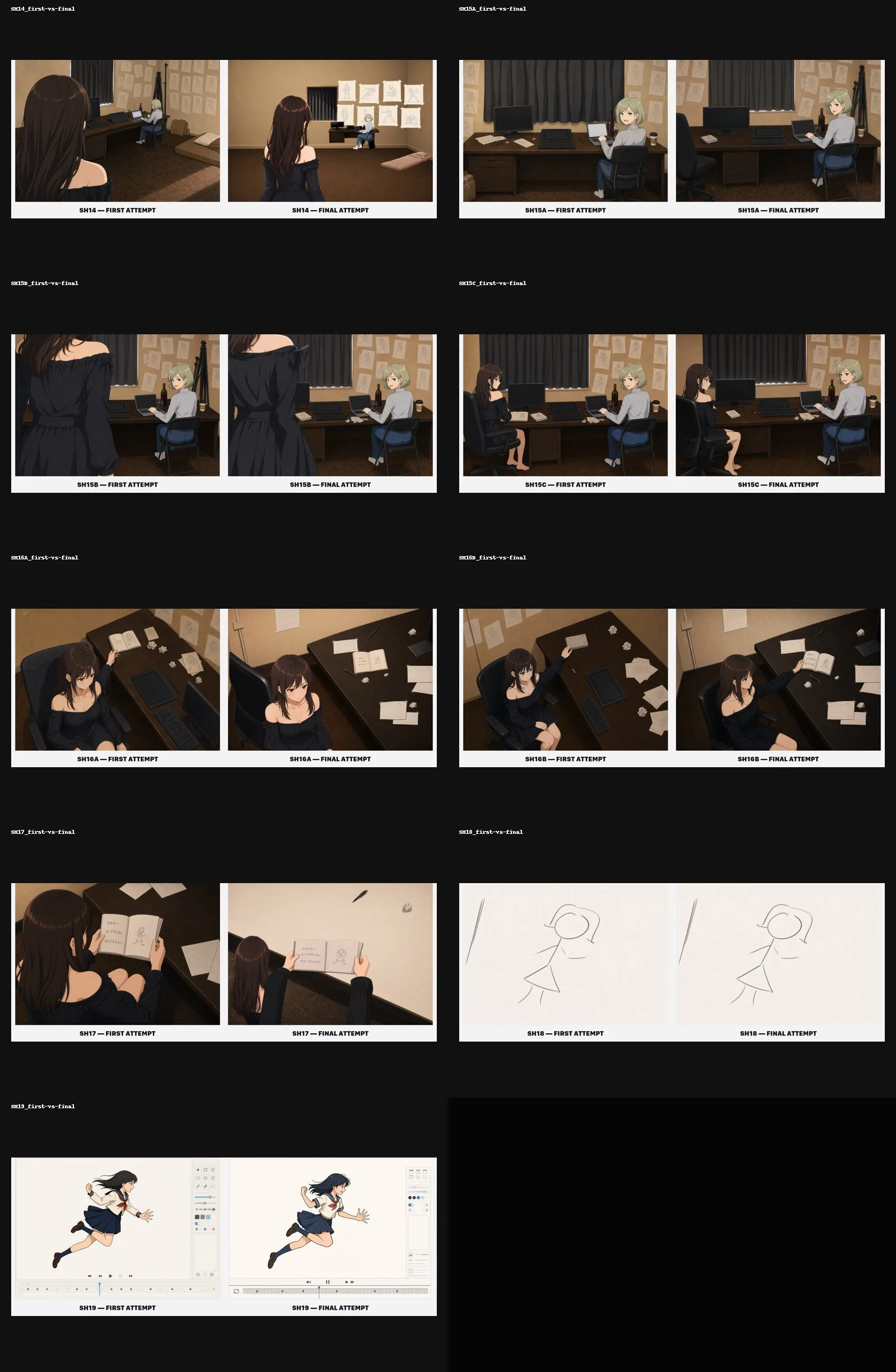
For Tegaki SH14–19, all nine first-attempt to final pairs from the current method are compared. The improvements come from locking the camera, holding actor scale, separating identities, and keeping each person's place in the frame legible.
Carry the spatial key into motion
In Tegaki Scene 1 Shot 1, the rough becomes a spatial key before it becomes motion. We do not accept the first result as the finish. We check where the camera, actor scale, pose, or acting slipped, then return that direction to the next iteration.
Rough → spatial keyframe → motion. Direction returns to the next iteration instead of ending at the first output.
Fix the room's topology
For the studio at night, the reference was extended into the accepted plate set. Keeping the desk, windows, drawing wall, walking lane, and lighting state in the same relationship lets the room remain legible when the shot changes. Rejected Plate 01 is excluded from this collage.

G / FINISHING
Close the film
The six-scene, roughly five-minute screenplay is complete. What remains is to close the shots, edit, and sound as one film through the fundamentals of pacing, writing, and drawing. The more AI tools enter the process, the more those fundamentals matter when choosing a candidate and naming the correction.
As a two-person team, we are aiming to finish the film by August 31, at the end of the month.